
The 90-Day GTM Plan I Use Before Any Founder Spends on Marketing
A GTM plan is not a 40-page deck. Here is the 90-day framework I use with founders before they spend a rupee on customer acquisition.
6/29/2026
QUICK ANSWER
A go-to-market plan should identify the right customer, the right channel, and the right price point, then convert that into a 90-day execution roadmap with weekly milestones. Most GTM failures happen because founders skip this and jump straight to advertising.
A founder told me last month he had spent Rs 12 lakh on Meta ads before he had confirmed which customer segment actually wanted his product. That is not a marketing problem. That is a sequencing problem.
Go-to-market strategy has become synonymous with marketing spend, and that is the mistake. GTM is not a marketing plan. It is a sequencing decision about customer, channel, and price, made before you spend anything.
What Is a GTM Plan Supposed to Answer
Three questions, in this order. Who is the customer who will pay for this today, not eventually? Which channel reaches that customer at a cost you can sustain? What price point makes the unit economics work at the volume you can realistically hit in 90 days?
Most founders answer these questions backwards. They pick a channel because it is trendy, set a price based on competitor benchmarking, and hope the customer shows up. That order fails more often than it works.
The 3C Framework, Applied Practically
We use the 3C framework, Company, Customer, Competition, as the starting lens. Company means being honest about what you can actually deliver at your current team size and capital. Customer means picking one segment, not three, to go after first. Competition means understanding not just who else sells your category, but who currently gets the budget you are trying to win.
A founder in the pet care space came to us convinced their competition was other pet brands. The real competition for their target customer's spend was actually premium human snack brands. The customer had a discretionary budget, and pet products were competing against self-indulgence purchases, not other pet products. That reframing changed the entire positioning.
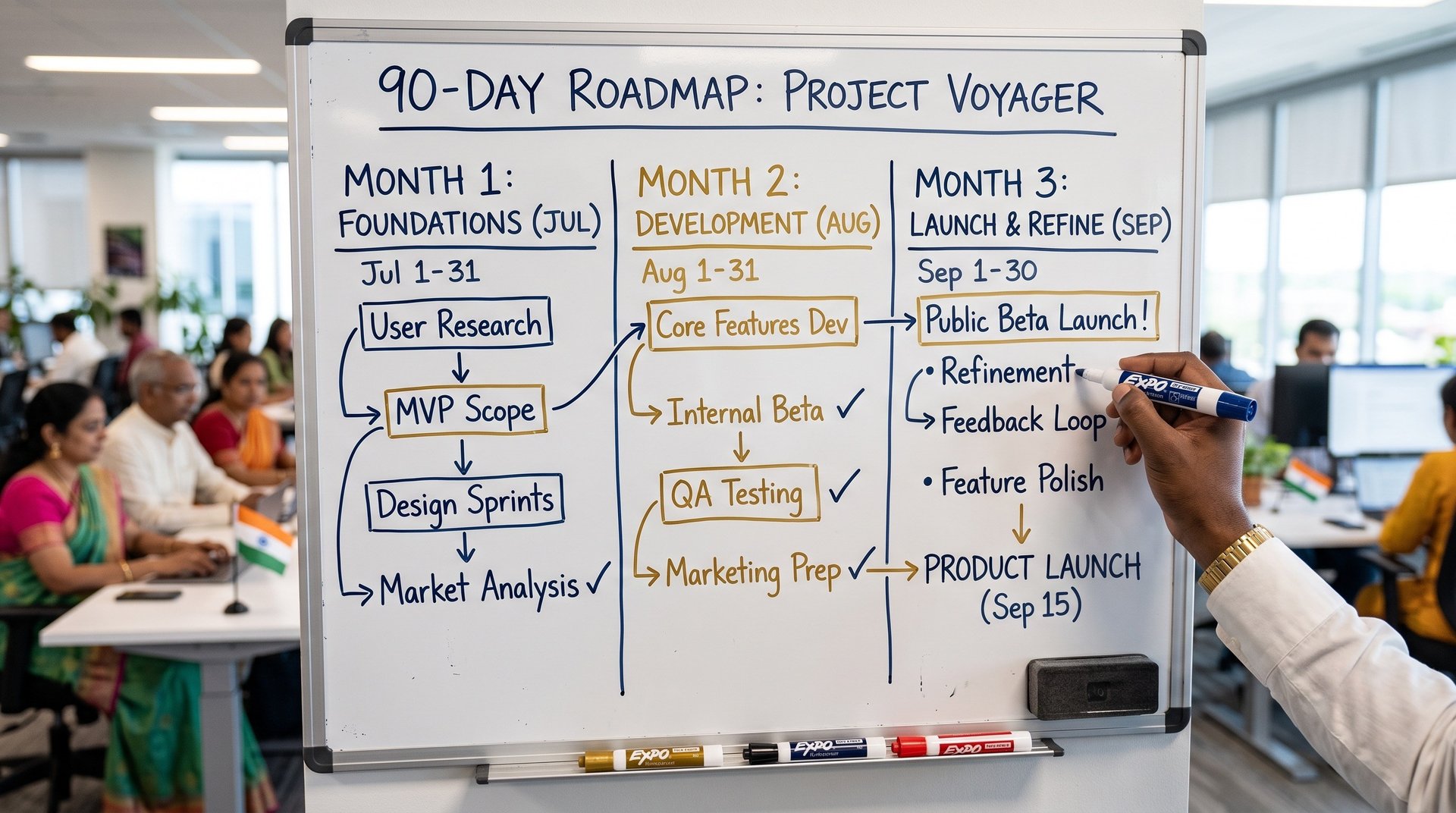
The 90-Day Structure
Days 1 to 30: Validate, Do Not Scale
Pick one channel. Not three. Run it at a budget you can afford to lose entirely. The goal in the first 30 days is not revenue; it is proof that the customer segment and channel combination actually converts at a CAC you can work with.
Days 31 to 60: Find the Repeatable Motion
If days 1 to 30 worked, this phase is about finding what specifically worked. Which ad creative, which price point, which messaging? Most founders skip this and just scale the spend, which scales the waste along with the wins.
Days 61 to 90: Scale With Guardrails
Now you increase spend, but with a hard CAC ceiling defined from the unit economics, not from ambition. If CAC crosses the ceiling, you pause and diagnose before continuing, not after the budget is gone.
A Real Example From a B2B Manufacturer
A manufacturer entering a new geography wanted to hire five sales reps immediately and cover the whole region. We ran the 3C analysis first and found that the actual addressable customer in that region, at the price point that worked, was a fraction of what they assumed. One rep, focused on 40 accounts, outperformed the planned five-rep rollout because the targeting was precise instead of broad.
What to Do Monday Morning
Before you spend on any channel this week, write down your answer to the three questions. Who specifically is the customer paying today? Which single channel reaches them most efficiently? What price point makes the unit economics work at the volume you can hit in 90 days?
If you cannot answer all three with specifics, not vague personas, that is the work to do before the ad budget goes out.
AmirashX's GTM & Market Entry Strategy engagement builds this 90-day roadmap with you, grounded in your actual unit economics, not a generic template. Learn more at amirashx.com.