
Gujarat Manufacturers Losing Margin: The D2C Opportunity Most Are Missing
Gujarat makes a significant portion of what India buys. Yet the margin, brand, and customer data goes elsewhere. Here's the conversation most manufacturers haven't had yet.
4/7/2026
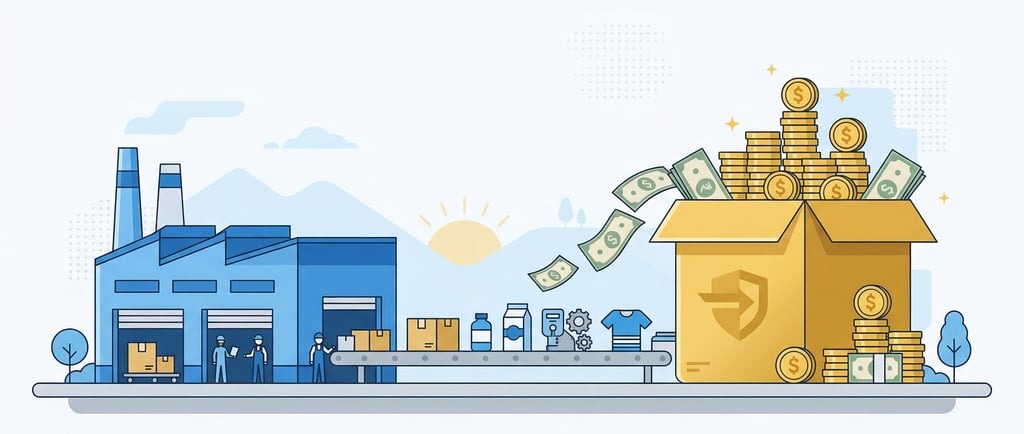
Gujarat Manufacturers Have India's Best Products. Most Are Giving Away the Margin.
Gujarat makes a disproportionate amount of what India buys.
Surat produces 40% of India's synthetic fabric. Rajkot is one of the largest engineering goods clusters in Asia. Vadodara anchors chemicals, pharma, and industrial manufacturing. Ahmedabad has built one of India's most diverse FMCG and consumer goods manufacturing bases.
The products are world-class. The margins that stay with the manufacturer often aren't.
A manufacturer in Surat producing a fabric-based consumer product might sell at ₹180 a unit to a distributor. That distributor sells to a retailer at ₹280. The retailer sells to a consumer, or a D2C brand buys it, builds a label around it, and sells online at ₹950. The manufacturer made ₹180. Someone else made ₹770 on their product.
This is not a complaint — it's the traditional model, and it's worked for decades. But it's worth being clear about what that model costs.
What the distributor model actually gives up
Margin is the obvious one. But the less visible cost is customer data.
The manufacturer who sells through distributors knows nothing about who ultimately uses their product. They can't reach that customer directly. They can't learn from what the customer loves or hates. They cannot build a brand relationship or drive repeat purchases.
A D2C brand selling the same product is collecting email addresses, WhatsApp numbers, review data, and repurchase behaviour with every order. That data makes their next product better, their next campaign more targeted, and their eventual valuation higher.
The manufacturer is providing the product that makes all of this possible, while owning none of it.
Why have most Gujarat manufacturers not moved
The honest answer: D2C is a fundamentally different operating model. Running a factory well requires precision, consistency, and long planning cycles. Running a direct consumer brand requires speed, iteration, and a kind of consumer empathy that B2B sales never develop.
Most manufacturers who've tried going direct have done it the wrong way — building a website and expecting orders to come, or handing it to an agency and hoping for the best. Without the internal capability to run a D2C business, the experiment fails, and the conclusion becomes "D2C doesn't work for us."
That conclusion is usually wrong. The execution was wrong.
What working looks like
The manufacturers building successful D2C channels from Gujarat in 2026 are doing one thing consistently: treating D2C as a separate business with its own team, its own metrics, and its own mandate — not as a marketing experiment bolted onto the existing operation.
They typically start with a product that doesn't compete with their existing distribution — a premium variant, a bundle, a category extension — that gives them a clean learning environment. They set a modest 12-month target (5 to 10% of revenue from direct) and focus on building the capability, not hitting a number.
And they find a partner who understands both sides — the manufacturing reality and the D2C execution model — because very few people actually understand both.
The window is still open
Gujarat's manufacturers have an advantage that pure D2C brands spend years trying to build: a real product, real supply chain, and real production capability. The brands currently taking the margin are dependent on manufacturers like them to exist.
The question is how long to let that dynamic continue unchanged.
[Let's talk about what a D2C entry looks like for your business →]